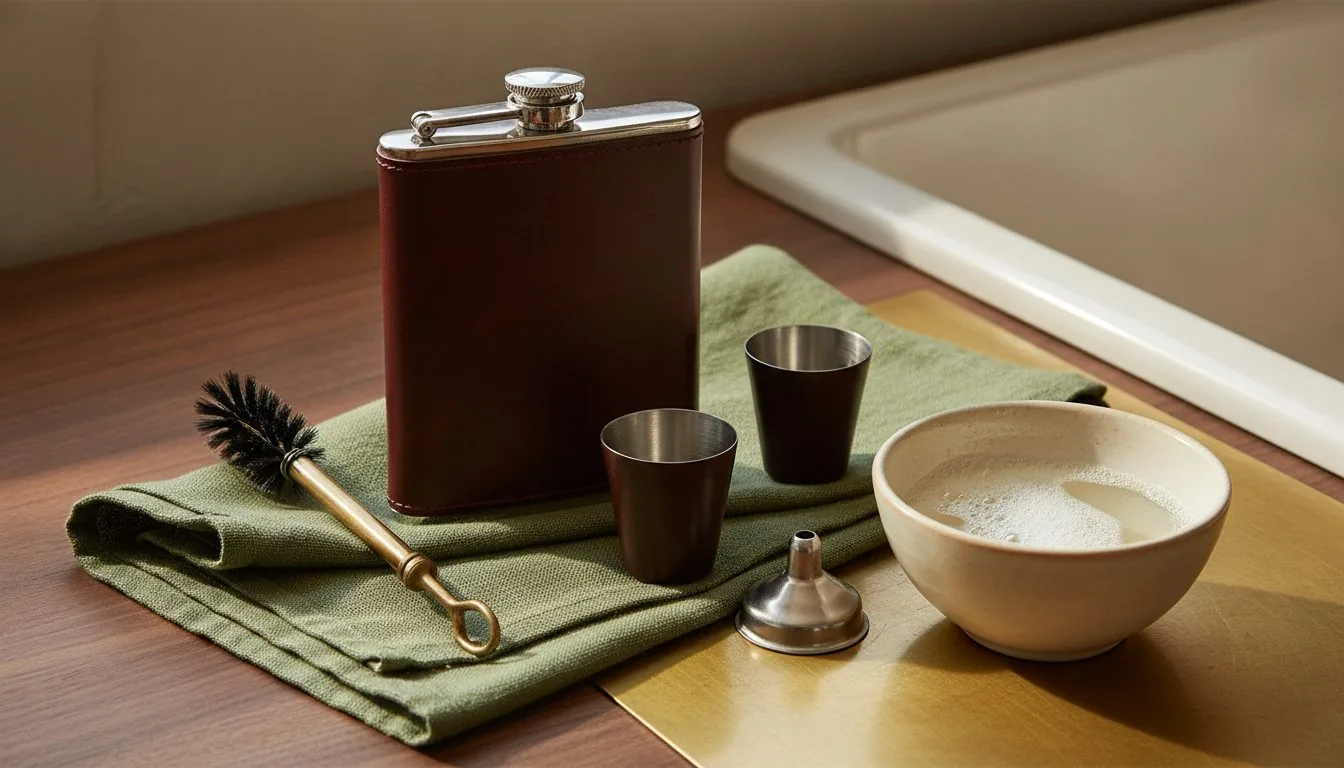
Quick Answer: Clean a hip flask by hand. Swish warm soapy water inside, rinse it well, and stand it upside down to drain. For a smell or a film, try diluted white vinegar, then rinse again. Stainless steel guidance warns against bleach, scouring powder and steel wool. Keep a leather wrap out of the water and away from heat, and do not put a wrapped flask in a dishwasher.
A flask is hard to see into, so cleaning it is mostly a matter of method. This guide covers the inside, the outside, what to avoid and how often to clean. The steel guidance comes from a stainless steel industry publication about cleaning steel in the home, and the leather guidance from National Park Service museum leaflets. Neither is about flasks, and the guide says where that matters. For the steel itself, see the stainless steel hip flask guide, and the guide to choosing a men's flask covers what to buy.
How do you clean a hip flask inside?
Use soapy water, rinse well and drain it upside down. The source is Cleaning Stainless Steel in the Home, a 2011 question-and-answer publication from Euro Inox, the European stainless steel market development association, hosted on worldstainless.org (checked October 2026). It names soapy water for grease and diluted vinegar for limescale, and says to rinse and wipe dry.
- Empty the flask and rinse it with water.
- Part-fill it with warm soapy water, close the cap and swish it around.
- For a film or a smell, use diluted white vinegar instead, then rinse again.
- Rinse until no soap or vinegar is left.
- Stand the flask upside down so it drains through the opening, and leave it until dry.
What the source does and does not cover matters here. It is about stainless steel in kitchens, such as sinks, pots and urns, not about flasks. It says nothing about caps, leather wraps or spirit residue. The vinegar is named for limescale, not smells, so using it for a smell is an extension. No source checked gives a vinegar ratio or a soak time for a flask, so this guide gives none. The steps are general stainless steel care applied to a flask.
How do you clean the outside of a leather-wrapped flask?
Wipe it with a soft cloth that is dry or barely damp, and do not soak it. The US National Park Service says researchers almost invariably find that leather dressings have no preservative effect (Conserve O Gram 9/1, July 1993, about museum objects, not flasks), so skip oils and conditioners. The leather flask guide covers the wrap in more detail.
What should you not use to clean a flask?
Bleach, scouring powder and steel wool, and go easy on heat. The table shows what the sources say.
| Avoid | What the source says |
|---|---|
| Bleach and bleach-based disinfectants | Euro Inox says concentrated ones can damage stainless steel, and diluted ones can make it corrode if left on too long or not rinsed off |
| Scouring powder and ordinary steel wool | Euro Inox says both scratch stainless steel, and ordinary steel wool can also damage its corrosion resistance |
| Cleaners containing chlorides | Euro Inox says to check the label for "Cl", since chlorides can damage stainless steel |
| Hot or boiling water on a wrapped flask | The Park Service says excessive heat dries organic materials such as leather and may embrittle them (Conserve O Gram 1/3, July 1993). Applying that to a flask is an inference |
None of the sources covers dishwashers for flasks. This guide does not recommend one, because a leather wrap is not something to put in a dishwasher. Wash by hand, and follow the maker's instructions if you have them.
How often should you clean a flask?
No source gives a schedule. The safe habit is to empty and rinse it after a trip, and to do the fuller clean above if it has sat unused. This guide gives no number of days, and it does not advise how long a drink can stay in a flask.
Do these steps suit the flask sold here?
Yes, with the wrap in mind. The Men's Leather Flask set in this post is our own product, sold on this site. It is an 8 oz stainless steel flask, given as 304 in the listing, wrapped in leather, with a hinged screw cap the site describes as leak-proof, two cups and a funnel. The listing gives no care instructions, so the rules above are cautious ones, not a maker's sheet. See the leather flask set, or the Home & Kitchen collection.
These steps are not the right method if your flask's maker gives different instructions. Follow the maker.
Frequently asked questions
How do you wash a flask?
By hand. Swish warm soapy water inside, rinse thoroughly and drain it upside down. Wipe a leather wrap with a soft, barely damp cloth.
How do you clean a flask inside?
Soapy water first. For a film or smell, use diluted white vinegar, then rinse until nothing is left. The source covers stainless steel surfaces in general, not flasks.
What is the best way to clean a stainless steel flask?
No source ranks the methods. The steel guidance checked here describes soapy water, diluted vinegar and thorough rinsing, and warns against bleach, scouring powder and steel wool.
Can you clean a flask with baking soda?
Euro Inox names baking soda for coffee deposits in urns, using boiling water, which it does not describe for flasks. Boiling water is not advised for a wrapped flask, so this guide does not recommend baking soda.
How do you dry a flask?
Stand it upside down so any liquid drains out through the opening, and leave it until dry. No source checked covers drying a flask, so this is practical advice, not a sourced rule.
Can you put a flask in the dishwasher?
Not a leather-wrapped one. No source checked covers flasks in dishwashers, and a leather wrap is not something to put in one.
How do you clean an alcohol flask?
The same way: empty it, rinse it, wash with soapy water, rinse again and drain it upside down. Wipe the leather outside with a soft, barely damp cloth.